Raccoon Removal in Ann Arbor
Raccoon removal in Ann Arbor has two parts that are easy to confuse: getting the animal out of the house, and closing the route it used.
This site handles neither.
This line takes calls about raccoons in the attic, walls or chimney, from trapping and removal to sealing the way in, and connects you with an independent wildlife control operator.
Call about a raccoon(734) 393-1161
A referral line, Washtenaw County
Raccoons and squirrels in houses. No other animals.
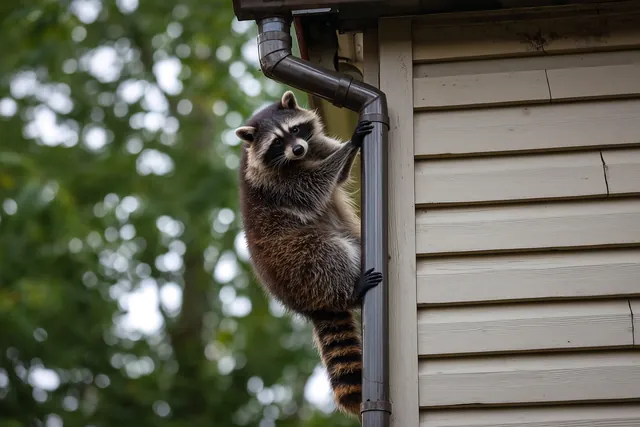
What is happening at your house?
Raccoon in the Attic in Ann Arbor
A raccoon in the attic of an Ann Arbor house: what night noise does and does not show, the breeding calendar, latrines and roundworm, and closing the attic.
In the atticRaccoon in the Chimney in Ann Arbor
A raccoon in a chimney in Ann Arbor: the Park Service line on chimney caps, the city's rental checklist item, young in a flue, and what the sources leave open.
In the chimneySquirrel Removal in Ann Arbor
Squirrel removal in Ann Arbor: which squirrels are active by day or night, what they do in attics and walls, and the metal the Park Service recommends.
SquirrelsA Raccoon in an Ann Arbor Rental House
A raccoon in a rental house in Ann Arbor: what the city's tenant booklet and rental inspection checklist say about the building.
Rentals
How it works
Call or write
The caller describes the animal, the part of the house and how long the problem has run.
Referral
The request is referred to an independent wildlife control operator, if one works at the address.
The operator calls
That operator telephones, inspects, and proposes a method and a price. Any agreement is between the householder and the operator.
Further pages treat the attic, the chimney and squirrel removal in turn. The contact page repeats the form with more room.
What is established about raccoons
The U.S. Forest Service review of the species calls raccoons "one of the most frequent nuisance animals reported by wildlife agencies in urban and suburban areas of the United States."
It describes them as typically nocturnal.
Mating runs from January to March across most of the range, mean litter sizes fall between two and five, and the young can generally walk, run and climb at seven weeks.4
Not established here
No source on this site's record says how often raccoons choose attics over other dens, or which parts of Ann Arbor see them most.
Neither claim is made.
Rabies, stated carefully
Two facts sit side by side.
The Washtenaw County Health Department reports that rabies has not turned up in the county's raccoons, and that the raccoon variant has never been detected in Michigan.1
The CDC places the raccoon reservoir in the eastern United States, from Canada to Florida and west to the Appalachians, and says rabid raccoons are rarely reported outside that region.2
Neither fact is a reason to handle the animal.
The CDC's general rule is to keep a distance from wildlife and never to approach an animal that appears injured or sick.3
A raccoon that behaves strangely may have distemper: the Forest Service calls that disease widespread in raccoon populations,4 and a federal study of 21 raccoons collected where rabies was suspected found every one of them nonrabid.5
For a bite, the county health department gives 734-544-6700 as its number during business hours, 8:30 a.m. to 5 p.m. on weekdays.1
Questions
Who carries out the removal?
Nobody connected with this site.
Its function is referral: the request is forwarded to an independent wildlife control operator, and that happens only where one works at the address given.
Has raccoon rabies been found in Washtenaw County?
The Washtenaw County Health Department reports that it has not, and adds that the raccoon form of the virus has never been detected anywhere in Michigan.
The CDC still advises keeping a distance from all wildlife.
Which animals does the line take calls about?
Raccoons and squirrels living inside a house: in an attic, a chimney, a soffit or a wall.
Other animals, pets and animals outdoors fall outside its scope.
What will the work cost?
The figure is not known to this site.
The operator who inspects the house sets it, and it is reasonable to ask for it in writing before agreeing to anything.
Sources
Sources
- Washtenaw County Health Department. Rabies.
- CDC. Rabies in the United States: Protecting Public Health.
- CDC. Rabies Prevention and Control.
- USDA Forest Service (Fire Effects Information System). Procyon lotor (Tesky, J.L. 1995), Fire Effects Information System species review.
- USGS (Patuxent Wildlife Research Center; Publications Warehouse record). Distemper in raccoons and foxes suspected of having rabies (Habermann, Herman, Williams; JAVMA 1958).
Michigan DNR pages, linked for further reading: Wildlife Damage and Nuisance Animal Control application and permit (form).
Raccoon or squirrel living in the house?
Call about a raccoon (734) 393-1161